
Home Amanda’s writing
The writing
What it actually reads like.
Three passages, written to show the style. They are examples, not real clients.
Every story is written in the voice of the person telling it, in plain words, close to the way they actually speak. No flourishes, no biography-shop language, and nothing tidied up into somebody else’s sentences. Below are three short passages, one for each of the situations people usually arrive in.
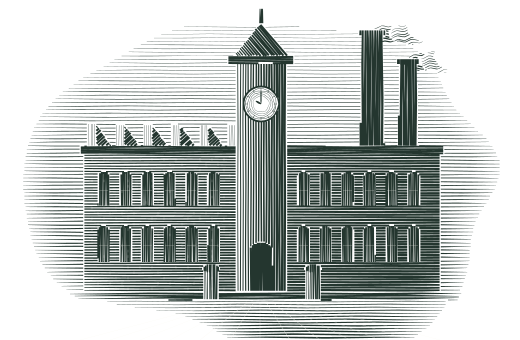
Passage i
A gift, for an occasion
I started on the factory floor at sixteen, sweeping metal shavings for four pounds a week, and thirty-eight years later they gave me a clock and a cup of tea in the same building. In between there was a wife, three children, a strike I still have opinions about1, and more good men than bad ones. Nobody had ever asked me to say any of that out loud before2, let alone write it down.
Written to show the style. Not a real client.
Passage ii
While there is still time
Some days I could not tell you what I had for breakfast, but I can still see the ballroom at the Locarno exactly as it was, and I can still hum the tune the band was playing the night your grandfather3 asked me to dance. Hold on to that one. That is the one that matters.4
Written to show the style. Not a real client.
He never once talked about the war in forty years, so most of what is in this book came from a shoebox of letters his sister had kept, and three photographs nobody could place until an old friend of his rang up out of the blue and named every face in them. It is not everything.5 But it is far more than we had, and more than we thought we would ever get back.
Written to show the style. Not a real client.
Passage iii
After they have gone
These are written examples, not real clients. Nothing on this page is taken from anybody’s actual story. Real work is private, and it stays private unless a family tells me otherwise.
Why it is written this way
Most life-story writing goes wrong in the same place: the writer smooths the person out. Dates get tidy, sentences get even, and the finished thing reads like a company history. Whoever is left reading it cannot hear the person in it, which was the entire point.
So I keep the way they say things.
If someone always says “your grandfather” rather than a name, that stays. If they circle back to the same story three times, the version that goes in is the one with the best detail in it, not the first one. If they are funny, it is funny. If they are blunt about somebody, that is a conversation to have with the family, not something I quietly remove.
You see a full draft before anything is finished, and you can change anything in it.
How it works sets out the process, and the Life Story covers what you end up with.
What happens to real stories
Every project is private. I do not publish anybody’s story, or a passage from it, unless the family specifically asks me to.
Over time, if and when families are happy to be named, real examples will replace the illustrative ones on this page. Until then, the most useful thing I can show you is the method itself, which is given away in full in the guides. Until then these stay clearly labelled as what they are.

I conduct every conversation myself, and I write every story myself. Nothing is handed off.

Talk to Amanda
How would your person read on the page?
If you want to know how your own person would read on the page, that is the conversation to have.
From £250. Nothing happens until you are sure.